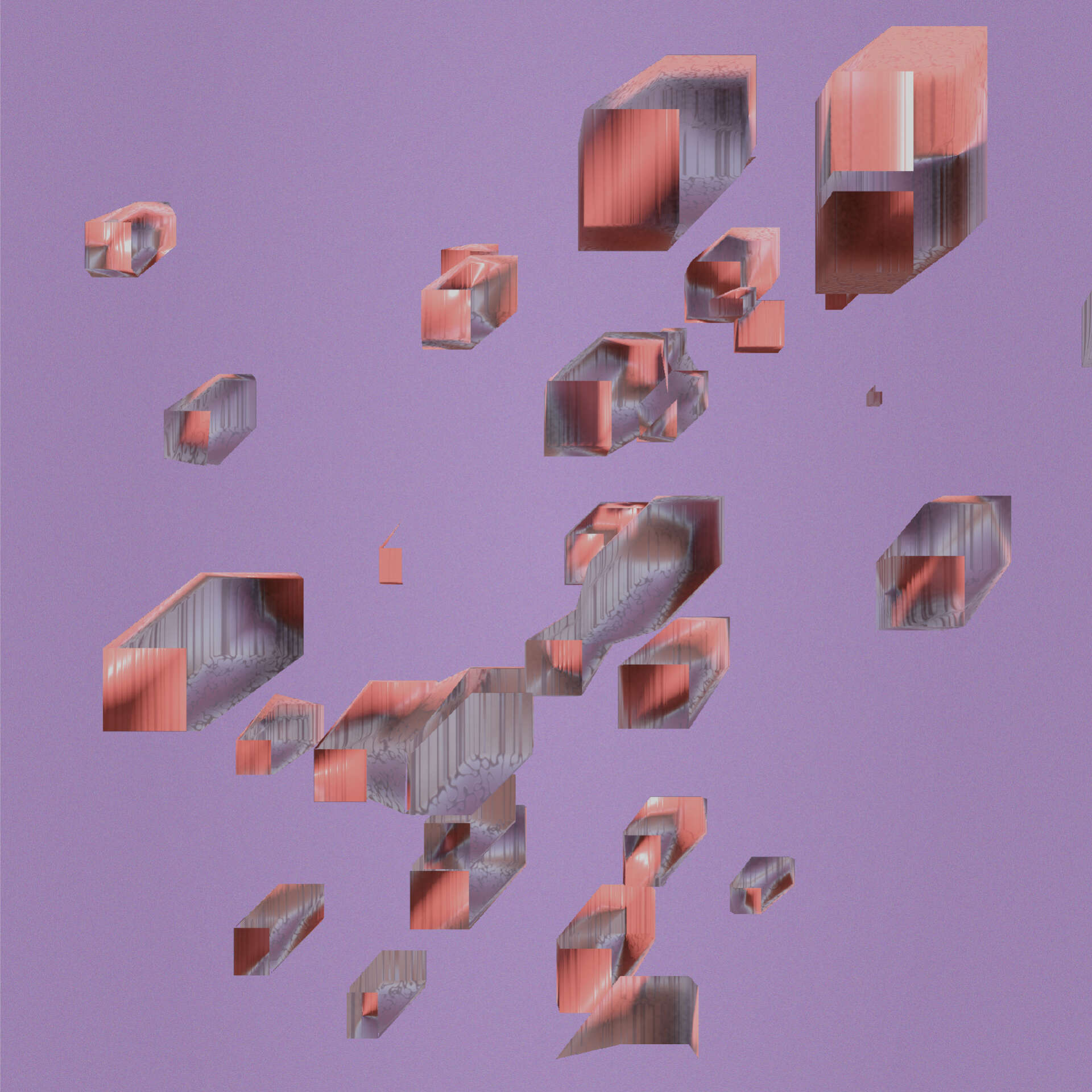
Student exhibition: Data Subjects
| Artists | Joshua Mattson, Grace Kim, 4L34M, Lana Požlep |
| Curator | Maša Žekš |

The student exhibition at Kulturni inkubator showcases four selected projects, each exploring, in its own way, the relationship between the body, technology, and the systems that shape our everyday lives. Although they draw on different media and address various fields – ranging from labour and the military industry to artificial intelligence and ecological loss – they are united by an interest in the individual who finds themselves within structures larger than themselves. In this context, the body is not merely a physical presence, but also becomes a user, a worker, a player, a citizen or a data subject.
The student projects on display converge at the intersection of the body and various forms of systemic operation. In the Anti-Work Simulator, the visitor, guided by the logic of a video game, finds themselves in an absurd regime of work, productivity and surveillance, where their own actions become part of the very system that the work criticises. Similarly, Defence Contractor Fantasy World employs the language of gaming and speculative fiction to link the body with automated violence, the military-industrial complex and technological capitalism. In Grace Kim’s work, the question of humanity is transposed into a digital interface, as Please Verify Your Humanity v1 explores the boundary between the human and the machine through movement, interaction and algorithmic recognition.
Lane Požlep’s Opera for 14 Butterflies approaches this relationship from the other side. Instead of a digital interface, it uses bureaucratic language, administrative procedures, sound, and space to construct an alternative archive of ecological extinction. Here, too, the individual is confronted with the system, this time the legal and institutional structures that determine how a particular loss can even be recorded, recognised and addressed.
Instead of treating technologies as neutral tools, the exhibition views them as environments that actively shape our behaviour, perceptions and capabilities. Videogames, algorithms, bureaucratic procedures and digital interfaces are becoming extensions of the body, whilst at the same time imposing new rules upon it. Between efficiency and inefficiency, recognition and exclusion, and control and resistance, the question arises as to what happens to the body when it becomes part of a system that it itself helped to create.
Maša Žeks
Joshua Mattson (freeculture.api) (1996) is a game developer, animator and media artist currently based in Linz, Austria. His practice encompasses games, animation and installation, exploring internet spirituality, hidden networks and hauntological 3D imagery. He holds a BA in Cognitive Systems from the University of British Columbia in Vancouver and a diploma in Post & Game Audio Production from Nimbus School of Recording & Media. He is currently pursuing an MFA in Interface Cultures at Kunstuniversität Linz. His work has been exhibited at Kunstuniversität Linz and Turm 15 in Austria, as well as Slice of Life Gallery in Vancouver.
Grace Kim is a filmmaker and media artist currently based in Linz, Austria. Working across moving image, interactive art and installation, her practice explores how linguistics and narrative evolve with the emergence of consumer-facing AI. As a filmmaker, she has directed narrative films, branded content and music videos, with her films screened at the Hamptons International Film Festival, Museum of the Moving Image and Brooklyn Museum. Her media art has been presented through programs including Arts Korea Lab’s AI Communication Super Testbed and the 2026 APE Camp hosted by ARKO. Her project Lingua AI received the Grand Prix at the AI x Art Hackathon at Seoul National University. She is currently pursuing an MA in Interface Cultures at Kunstuniversität Linz.
Alessandro Ambrosini (2002) is a multimedia artist working under the alias 4L34M. His practice moves between video, VFX, graphic design, live performance, interactive installation and video games. Growing up in the Italian Alps and later moving to Milan, he studied film before turning towards other forms of media and artistic practice. His work explores the relationship between bodies and systems, with a particular interest in what happens when bodies encounter structures that were not designed for them. He is currently pursuing a master’s degree in Interface Cultures at Kunstuniversität Linz.
Lana Požlep (2000) is an interdisciplinary artist whose work is rooted in photography but extends to spatial arrangements, installations, sound and sound sculptures. In her work, she explores the structure and identity of the city, particularly the processes of construction and regeneration as a reflection of current economic and political decisions. She is interested in questions of urban identity, accessibility to the city centre, and the social practices and groups that are incorporated into its regenerated image or pushed to the margins. In her recent projects, she has addressed issues of ecosystem conservation, the use of space and the assessment of its loss. Požlep is currently completing her postgraduate studies in photography at the Academy of Fine Arts and Design in Ljubljana, and has undertaken further training at UMPRUM in Prague. She is the recipient of the ALUO Prešeren Student Award for the project Ponjava 4, and has held solo exhibitions at P74 Gallery and DobraVaga Gallery in Ljubljana, at the Maribor Photography Festival and at the Budapest Gallery in Budapest. She has taken part in group exhibitions including Premiere – 5th Triennial of Young Artists, Different Worlds and Space with a Potentiality for a Shift.