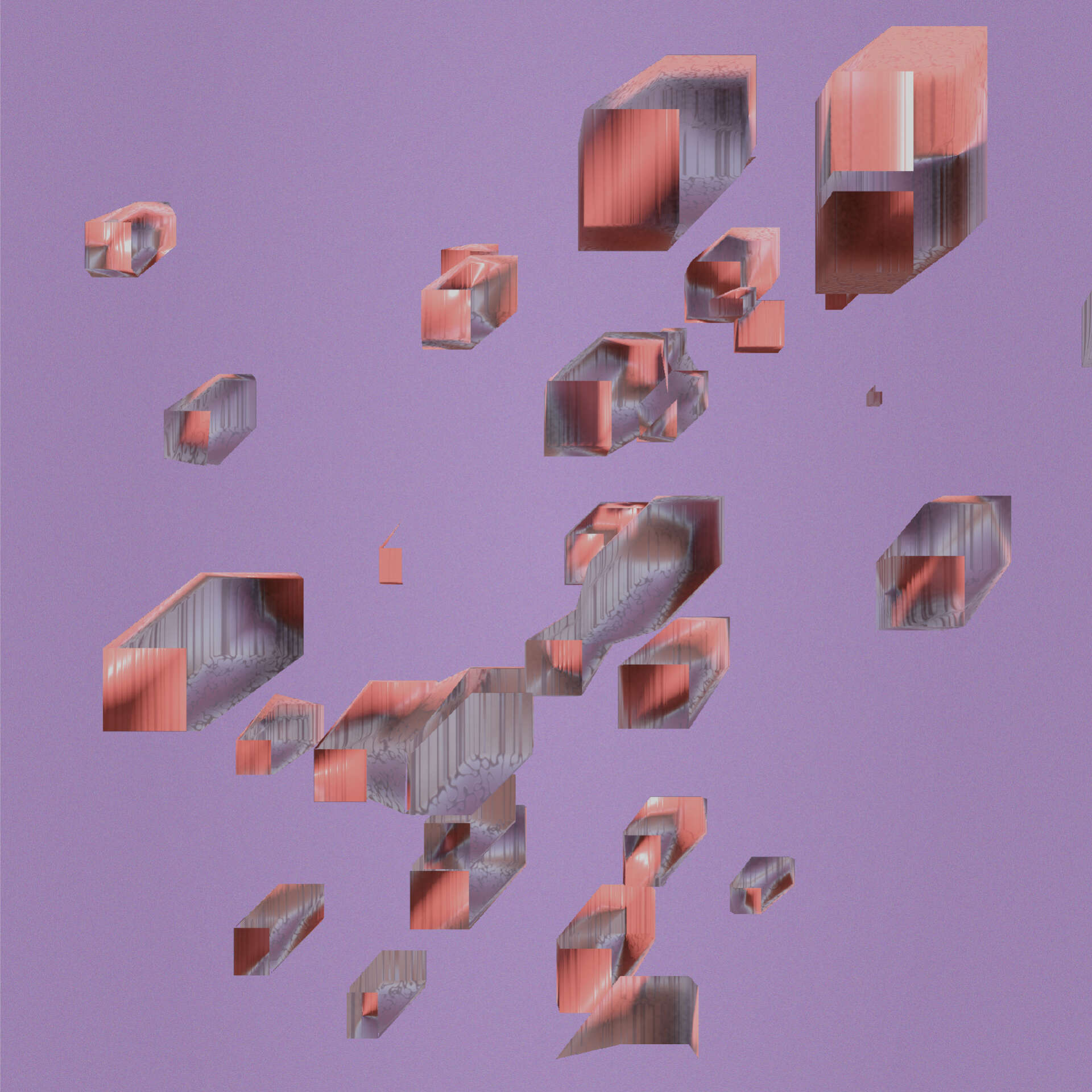

Andrej Škufca developed the BESM360-Kitov for the Ultrastructures series. It is based on fragments of military and civilian infrastructure scattered across Eastern Europe. The artist explores how the human environment and the structures created by humans become autonomous. The superfluity of the body is revealed in the involuntary participation of the individual, who is gradually overwhelmed by the scale of networks and systems that begin to dictate the rhythm of life, actions and ideology. The body becomes alienated, subordinated to the autonomy of technology that was originally created as an extension of the human being. The locus of control shifts: creations intended to increase control over the environment become self-sustaining, self-aware and take control of their creator. Without our consent, we thus constantly enter systems operating beyond the full scope of our understanding and control.
“The objects featured in the series are based on military and civilian infrastructural fragments scattered across Eastern Europe that for a time formed parts of what is by now an almost forgotten era of socialist and communist dreams. The BESM360-Kitov is a 5th generation node within the network inspired by Anatoly Kitov’s designs for an automated flow of resources in a system.
Based on Kitov’s proposals in the early 1960s, academics and politicians from socialist and communist states began to seriously consider the use of automation in a command economy. Anti-bureaucratic and decentralizing in principle the network of nodes envisioned a new technocratic revolution based on mathematical models that would automate production across entire states interconnecting all factories, oil fields, mines, power plants and other contributors. Fearing that socialist progress in cybernetics would result in a tremendous advantage pushing the Eastern bloc’s economy far ahead of its Western competitors, the CIA established a special branch to study what it perceived to be a significant threat.
Drawing on science fiction, technical designs, and the infrastructural forms supporting our digital economies, the object here taps into the historical development of digital technologies and aspirations for a different future to speculate about a world they might give rise to while playing with the ambivalent sentiments tied to their unrealized potential.”
Andrej Škufca’s (1987) work presents itself as a network characterized by fiction, technological
design, industrial fabrication processes and synthetic materials. His installations not only combine technological and fictional elements, but produce immersive and seemingly animated environments, in which human agents are no longer central. He has had solo shows in Coastal Galleries Piran, New Joerg, Vienna; Močvara, Zagreb; Aksioma, Ljubljana; The International Center of Graphic Arts, Ljubljana; Miroslav Kraljević Gallery, Zagreb; Karlin Studios, FUTURA, Prague; DUM Project Space Ljubljana. And participated in group shows in MAXXI - National Museum of XXI Century Arts, Rome; Ludwig Muzeum, Budapest; Museum of Contemporary Art Metelkova, Ljubljana; Het Niewe Institut, Rotterdam, Nitja in Oslo and Gallery of Modern Art, Ljubljana. He is also an editor at Šum journal. www.andrejskufca.com[S1]