
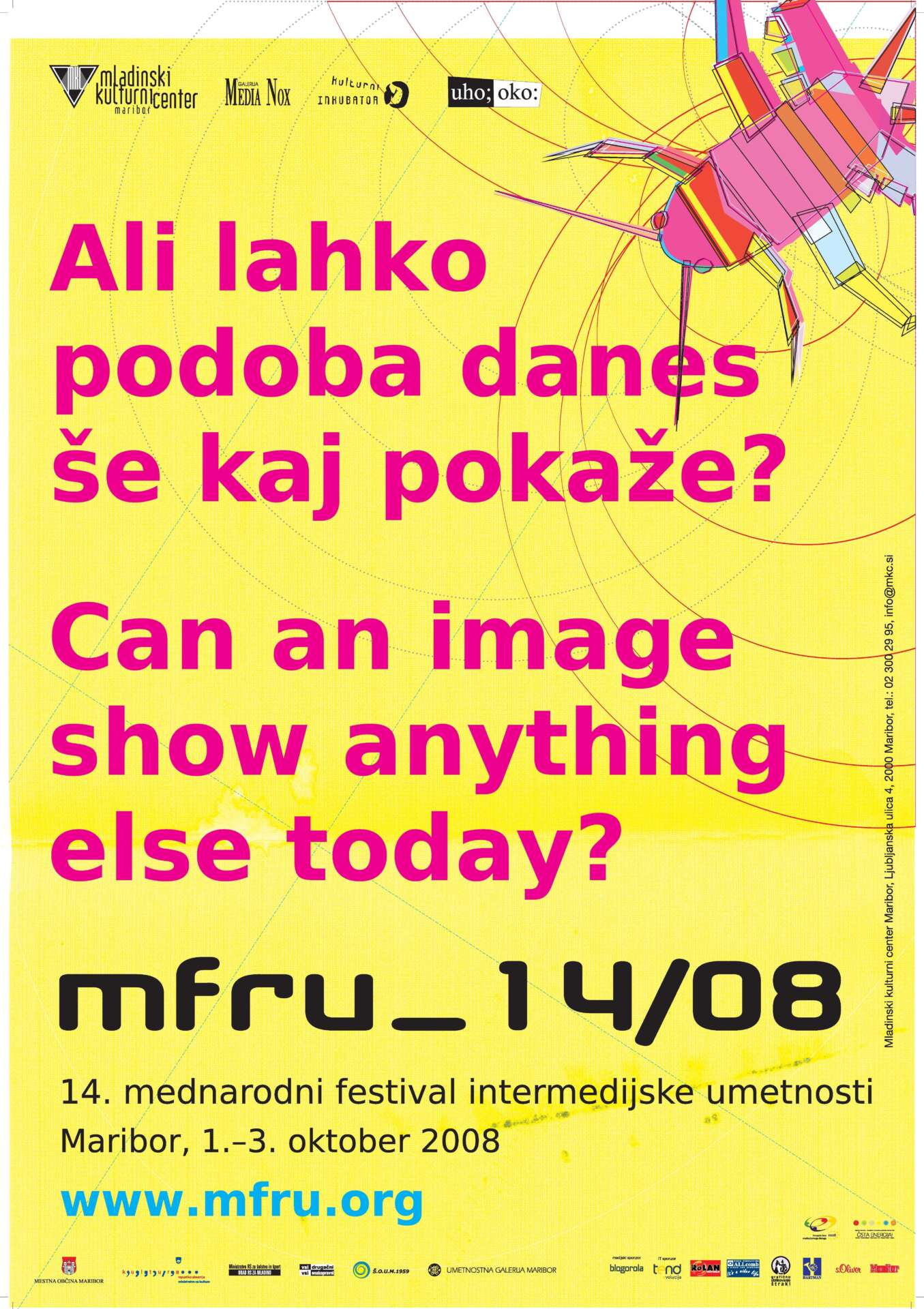
14th MFRU Can an image show anything else today?
01.–03. October 2008, Maribor, Slovenia
The 14th edition of the festival is shaped by a Program Council consisting of Melita Zajc, Marko Ornik, Marko Brumen, and Jože Slaček, and an Organizing Committee consisting of Aleš Novak, Marko Brumen, Marko Ornik, and Jože Slaček. In 2008, the festival will feature the participation of 14 Slovenian and 15 international artists and groups from Germany, the United Kingdom, Serbia, Austria, the United States, and France. The festival program presents top domestic and international authors and projects that are original, groundbreaking, and well-recognized in the field of intermedia arts. The program includes Slovenian, European, and global creators with the aim of fostering exchange of knowledge and ideas. The festival provides insight into current developments in intermedia arts and facilitates interaction between Slovenian audiences and international productions, increasing awareness and use of intermedia projects. It also promotes intercultural dialogue and collaboration.
The program of the 14th festival is based on the question "Can the image still show something?", which serves as a starting point for the symposium, exhibition, and proposed projects that present possible answers. The festival's projects include exhibitions of pioneers in computer art such as Ed Zajec, who explored new possibilities in imagery, and Marius Watz, who works in the field of computer-generated forms. One of the main features of the festival is the intertwining of the visual and the auditory, which expands beyond the exhibition space into the city itself. A series of urban interventions make the festival accessible not only to audiences but also to passers-by and the broader public, involving them in the project and its execution. Some of these interventions will allow visitors and passers-by to engage in live art creation through projections on the facades of buildings in the city center. The intertwining of the visual (image) and the auditory (music) is a key feature of the intermedia arts represented at the festival. The selection of works emphasizes innovation, creativity, experimentation, and the blending of musical expression through sound and image generation using various electronic devices and computers. These performances will take place in open urban spaces. Overall, the festival is designed to inform and invite the public to engage, encouraging a more responsive local audience while also strengthening international connections. In line with the festival's conceptual and foundational goals, we will once again invite multimedia centers that operate within the M3C – Multimedia Centers Network of Slovenia to collaborate.
"Can the image still show something?"
On the potentials of the image medium
Visual media are an inseparable part of the development of human communication, yet it seems that images impoverish rather than enrich societal communication. With the development of digital media, image creation has become an integral part of everyday life for much of the world's population. At the same time, the images produced daily in millions largely conform to traditional codes of figuration and narration, thus maintaining the negative traits of visual communication identified by critics of the society of spectacle and simulation at the end of the previous century. In this context, the experiences of pioneers in digital art, who primarily used computers to explore new potentials of the image medium, become relevant once again. These pioneers developed a visual language beyond realistic imitation and linear narration.
This is our starting question. Are visual media necessarily tools for imitating the outside world and linear storytelling that serve to reinforce dominant ideologies, i.e., tools of hegemony? Or can the experiences of digital art pioneers be understood as an impetus for creating images and visual languages that, in the words of Ed Zajec, are "new ways of imagining the world," and perhaps even a different world?
We would like to present as broad a spectrum of possible positive answers as possible. This would include the reflections and works of potential innovators, researchers, and creators in this field, from pioneers of computer art (such as Ed Zajec) to creators of new digital cinematographies, including Nigerian video film culture as an example of creativity within the medium (anti-realism, fantasy).
– Melita Zajc
MFRU 2008
Colophon
| Coordination, Artistic director | Marko Ornik |
Producent
-
Zavod uho; oko: